

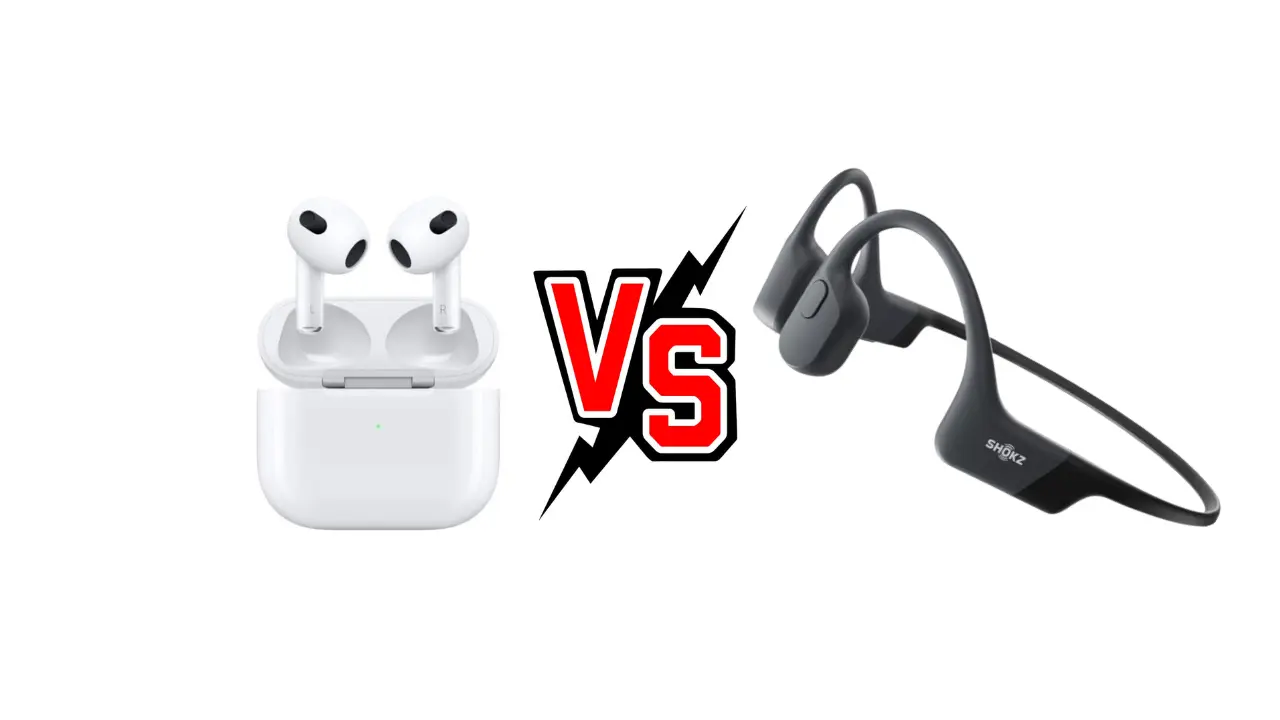
Shokz and Apple are two of the biggest names in commercial earphones. Even though their target markets differ somewhat, both are popular among people with various backgrounds and interests. So, which one will suit you best? Will you be better off with the Shokz OpenRun, or should you opt for Apple’s AirPods? I’ve been using both for a long time, so let me share what I found.
Verdict
Apple’s AirPods, which use air conduction, have better sound quality and volume—especially with the 3rd Gen. They are also much smaller and come with a charging case for added battery life.
The Shokz OpenRun uses bone conduction technology, making it the better option for exercise and sports enthusiasts who need near-perfect environmental awareness. The sound quality is good but not as pure or loud as the AirPods, but it is more water resistant.
Technology and Features
Technology is the main differentiating factor between the two earphone models. It has impacted the way I’ve been using the two devices to where I don’t really see them as competing devices anymore. Allow me to explain.
The Shokz OpenRun uses bone conduction technology, transmitting sound vibrations directly into your inner ears through your skull. On the other hand, AirPods use conventional air conduction technology, where the soundwaves travel through your outer ears using vibrations in the air.

Because of the different technologies, the two devices differ significantly in sound quality and use cases, but we’ll discuss that in more detail later.
Regarding water and dust resistance, the OpenRun is a clear winner. It has an IP67 rating, so it’s highly resistant to dust and can withstand liquids up to a depth of 1m (3 ft 3 in). The 3rd Generation AirPods only have an IPX4 rating, so they have no dust resistance rating and will only withstand water splashes. Older models, like the 1st and 2nd Generation AirPods, have no IP ratings.
In summary, 3rd Gen AirPods should handle sweat and some light rain without a problem, but I get a bit nervous wearing them even in a light drizzle. The OpenRun is the better option for anyone who will be spending lots of time running or cycling in wet conditions.
Design, Build Quality, and Comfort
It’s difficult to criticize either model for their build quality. Apple is notorious for paying close attention to the finest details of its products. Shokz, as a significant competitor, followed suit, and its devices are built to be strong, durable, and comfortable. But there are some essential differences.
Apple’s AirPods are similar to the brand’s wired earphones, EarBuds, in form factor. There are two separate wireless earbuds that come in a carry case (which doubles as a charger). You simply fit the earbuds in your ears to listen to music. Each 3rd Generation earbud weighs 4.28g, or 4g, in the case of the 2nd and 1st Gen models.
The OpenRun is a single unit. It has two earpieces connected by a thin wire strap. The earpieces loop over your ears so that the vibrating transducers are positioned just in front of them, with the strap running around the back of your head and over your neck for added support. No part of it goes inside your ears.

The design differences lead to vastly different comfort levels.
Apple’s AirPods don’t have ear tips. This means they won’t necessarily fit nicely in everyone’s ears and could slip out easily. For example, I’ve noticed that they tend to slip out a bit when I’m doing vigorous exercise. They can also become a bit uncomfortable after a while, especially when I’m listening to music in bed with my ear on my pillow.
OpenRun, on the other hand, tends to be more comfortable. There are no parts that fit inside your ears, so there’s nothing that can fall out when you move around a lot. It weighs 26g, a bit heavier than the AirPods, but not so much that it makes the headphones uncomfortable.
The device fits snugly against your temples. However, your mileage may vary since some people find the pressure and vibrations caused by bone conduction headphones irritating. It’s also worth mentioning that some people experience dizziness and vertigo after using bone conduction headphones for extended periods, though it isn’t widespread and I’ve never experienced it.
People who wear glasses or plan to wear sunglasses with earphones might prefer AirPods. Though the OpenRun isn’t uncomfortable with most glasses, it adds pressure over your ears, which doesn’t happen with the AirPods.
Sound Quality
Sound quality is often the deciding factor when choosing headphones, and it’s a significant consideration in this case.
As technology currently stands, bone conduction has improved in leaps and bounds. However, the quality and volume of bone conduction headphones still don’t quite match that of high-end air conduction devices.
Don’t get me wrong—the OpenRun has good quality sound, but the limitations of bone conduction technology mean that it’s nowhere near audiophile level. Music can feel slightly flat because it lacks bass. Podcasts sound great, but the low volume and open-ear design affect my listening experience in noisy environments like busy gyms or heavy traffic.
Apple’s AirPods aren’t audiophile earphones, either. They don’t have any form of active noise cancellation, and the fact that they don’t have ear tips means they’re not that good at passively filtering out noise. However, the music going straight into your ear canals through air conduction means you have a more full-bodied experience with solid bass.
Notably, the 3rd generation AirPods significantly upgrade their sound quality, especially the bass and midrange, compared to the 1st and 2nd generations.

Controls
The Shokz OpenRun has three control buttons: a Volume Up (which also doubles as the power button), a Volume Down, and a Multifunction button. The Multifunction does most of the general things you would like to do, like play, pause, skip, and answer calls. It’s located in a convenient position in front of your ear.
Some people don’t like physical buttons since they can be challenging to use while running. I never had that problem, but I can understand that some people will find it inconvenient. For them, AirPods might be a better option.
3rd Generation AirPods have force sensors on their stems. You can control playback, answer calls, and use Siri by pressing against the force sensor. 1st and 2nd Gen AirPods have tap sensors, which you can tap to do the same. Unfortunately, these sensors don’t control the volume, so you must do that manually on your phone or tell Siri to raise or lower the volume.
Battery Life and Charging
AirPods come with charging cases. Some cases have lightning ports to connect to charging cables, while others support Qi wireless or MagSafe charging.
1st and 2nd Gen AirPods have a standard lightning charging case, so you can charge the case with the same charging cable you use with an iPhone. They don’t ship with wireless charging cases at all.
The 3rd Gen AirPods let you choose between the standard Lightning Case (with no wireless charging support) and the MagSafe charging case. The MagSafe case can be charged on a Qi-certified charger or a MagSafe charger (including the Apple Watch charger), but it also has a lightning port if you prefer to charge it that way.
The OpenRun comes with a sturdy magnetic charging cable with fast charge support. It has no charging case or wireless charging option.
The 3rd Generation AirPods have up to six hours of listening time, which is an hour more than the previous two generations, but it goes down to five hours if you use spatial audio. That doesn’t sound like much, but keep in mind that the charging case can give you an additional 30 hours of listening time, and even five minutes of charging will give you another hour.
The Shokz OpenRun is a bit simpler. It gives you eight hours of listening time, and ten minutes of charging will give you an hour and a half to listen to your music or podcasts.
Price and Value for Money
Both devices offer good value for money, but the value will depend mainly on your needs. The OpenRun’s price is more or less on par with the 2nd Generation AirPods. The 3rd Gen is a bit more expensive but includes spatial audio and longer battery life. The AirPods and OpenRun are both good, high-quality products with excellent support from their manufacturers.
Use Cases
Shokz makes no secret that its products cater mainly to athletes and sports enthusiasts. The OpenRun’s open-ear format allows for excellent environmental awareness, so running or cycling is much safer when wearing them. However, they are also convenient for everyday wear. You can listen to your music at home or in the office without losing track of what’s happening around you.
AirPods are smaller and less conspicuous. They cater more to general-use listeners instead of targeting a specific niche. You can still use them while exercising, but you won’t have the environmental awareness that OpenRun offers. However, their main selling points are their improved sound quality and the ability to charge them on the go.
Between the two, I prefer the OpenRun for my daily run because of its comfort and environmental awareness. However, when I go to the gym, I opt for the AirPods because they are better at drowning out the gym’s music and noise, letting me listen to my music in peace.
Before you go…
The most significant differences between AirPods and the OpenRun are air conduction and bone conduction technologies. If you’re still unsure which one you prefer, you might want to read more about the differences in this post.