

In a world where AirPods reign supreme, the rise of counterfeits has become a significant concern. This guide helps you discern genuine AirPods from fakes, ensuring you get the quality and authenticity you deserve.
Key Takeaways
- Retailer Reliability & Price: Trustworthy retailers and realistic pricing are key indicators of authenticity.
- Packaging & Contents: Genuine AirPods feature high-quality packaging with complete, specific contents.
- Physical Examination: Check for any discrepancies in the AirPods and charging case’s build quality and design.
- Serial Number Check: Verify the serial number on Apple’s website for authenticity.
- Pairing Process: Genuine AirPods offer seamless pairing with Apple devices, unlike their counterfeit counterparts.
- Functionality Tests: Use sound cues and Apple app integration to confirm real AirPods.
Is The Retailer Likely to Sell Fake AirPods?
We will start with some obvious things first. Depending on where you buy your AirPods from, that should already give you a good indication. It won’t necessarily tell you if the AirPods are fake, but it could tell you if they’re not. For example, buying AirPods from an Apple Store is one way to know they are genuine.
The price can also be a good indication. If the price is ridiculously low (especially if the AirPods are brand new), they are likely fake (or stolen).
It can be more challenging to determine when you’re buying from smaller shops or through private sales. That’s where the other indicators come in.
The AirPods’ Packaging Quality and Contents
When you look at the packaging of your AirPods, you can often notice some differences. Apple ships its products immaculately packaged in vibrant packaging with plenty of fine details. Unboxing even the simplest Apple products is an exciting experience because of how enticing the packaging looks.
Unless the manufacturer of the fake products went through a lot of effort, you should notice that the packaging isn’t as immaculate. There might be spelling or grammar mistakes on the box, and it might be faded or slightly off-color.
The contents should also match the original Apple packaging contents. Apart from your AirPods and the charging case, you should have a manual, warranty card, and safety sheet. If the package was sealed when you received your AirPods and any of those items are missing, there’s a high likelihood that your AirPods are fake.
The Charging Case
There can be a few telltale signs on the AirPods’ charging case. Apple takes great care to ensure high-quality manufacturing, while the makers of counterfeit AirPods take many shortcuts to keep the costs as low as possible.
This means you could notice things like scratches, dents, or loose hinges. Some fake AirPods charging cases also have blue LEDs or the LEDs could be located in strange places instead of the front of the case. The control button should also be flush with the case and barely move when you press it.
Another factor that could be a dead giveaway, especially if you’re buying second-hand AirPods, is the charging connector. Previously, all AirPods’ charging cases came with a lightning port for charging, while many counterfeits used USB-C. Since Apple has now adopted USB-C as a standard, that no longer applies to many of the newer AirPods, so that alone is no longer a sign of fake AirPods.
Signs On The AirPods Themselves
Just like the makers of fake AirPods take shortcuts with the cases, they do the same with the AirPods. If you know someone who bought the same generation of AirPods, compare yours with theirs and look at the fine details to see if you can spot any differences.
You can look for obvious problems, like loose meshes over the speakers, inadequate fastening, and clearly noticeable seams. But apart from that, you can also compare the shapes. They should be relatively identical.
Many fake AirPods replace the pressure-sensitive indent with a control button or remove them entirely.
Essentially, look out for any differences between your AirPods and a legit model, even if you compare it with photos on Apple’s website.
Verify the Serial Number
Apple prints the AirPods’ serial number in a few places. You can find them on the outside of the packaging, so if you still have the original packaging, check that. The serial number is also printed on the bottom of the charging case and, in the case of the AirPods Max, underneath the detachable magnetic ear cushion on the left side.
First, verify that the serial numbers correspond between the charging case (or the AirPods Max) and the packaging. If they are AirPods with a charging case, and you’re buying them second-hand, it’s possible that the case was replaced at some point; then the serial numbers won’t correspond.
Next, enter the serial number on Apple’s device coverage website. This should tell you whether the serial number is a legitimate Apple AirPods serial number. If it doesn’t find the serial number, it definitely means you have fake AirPods. However, some manufacturers of fake AirPods still use legit Apple serial numbers, so finding it there doesn’t necessarily mean your AirPods are definitely real.
Pairing and On-Device Checks
No matter how well-manufactured fake AirPods are, one method almost always shows if your AirPods are real or not: pairing the AirPods.
Apple’s ecosystem works so fluently and flawlessly that pairing your AirPods with an iPhone differs entirely from regular pairing. The pairing process should start automatically when you open the case and bring it close to your iPhone.
If it doesn’t, or you get an error message saying that you will have to pair them conventionally, your AirPods are likely fake. You can also listen to the sound your AirPods make when they connect. Real AirPods only play a tone, while some fake AirPods have a voice that says “Connected.”
After pairing your AirPods, you can also try to use the Find My app. Genuine AirPods will appear and be traceable in Find My, while counterfeit models won’t.
It can be helpful to check your device’s settings. Genuine AirPods have a dedicated section in the iPhone’s Settings, while counterfeits don’t. When you open Settings, right above Airplane Mode, you should see your AirPods listed there (after pairing them and connected, of course). If they’re not there, they aren’t genuine.
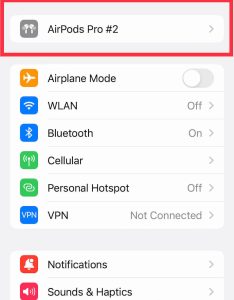
Another test that’s often overlooked (especially with AirPods Pro) is the “Ear Tip Fit” test. On your iPhone, open Settings and go to “Bluetooth.” Put your AirPods in your ears, then tap on the i icon next to your AirPods on the iPhone. Open the “Ear Tip Fit Test” and press “continue” then “Play.”
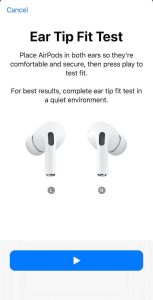
When it starts playing, remove your AirPods deliberately from your ears.

The test should stop because the AirPods detected that you removed them. If it keeps on playing, you probably have fake AirPods.
Of course, none of these checks will be available on an Android phone since AirPods were designed to work with an iPhone, and most of their advanced features are limited to Apple devices.
Conclusion
Fake AirPods have been flooding the market, and most people are looking for bargains, which these counterfeits might seem to be. But no fake will ever be able to perfectly replicate the quality and advanced features of true AirPods. Now that you know what to look out for, you should be able to buy confidently, knowing that your AirPods are legit and offer the quality you expect.